The Fortified City
The city of Dion was one of the most important cities of the Macedonian kingdom, as in addition to its strategic geographical location, it was also the location of the official places of worship of the Macedonians.
The existence of a settlement in Dion is attested as early as the 5th century BC, next to the places of worship of Zeus and the Muses.
A little later, at the end of the 4th century BC, the Macedonian king Cassander fortified the city with imposing walls that enclosed an area of 430 acres.
What might it have looked like?
The city of Dion was built on flat ground, with an almost square shape and was laid out with the Hippodamian system.
Essentially, this system is the use of perpendicular and parallel streets that create building blocks.
Throughout its centuries of existence, the city experienced successive building phases with periods of great prosperity, but also of destruction and plunder.
With the Battle of Pydna, in 168 BC, the Macedonian kingdom was conquered by the Romans.
More than a century later and after the naval battle of Actium, in 31 BC, the first Roman emperor, Octavian Augustus, founded a Roman colony in Dion. Its name was Colognia Iulia Augusta Diensis [Colony Julia Augusta Diensis].
The city of Dion experienced great economic and cultural development during the 3rd century AD. At that time, there was an extensive reconstruction of the political center of the colony and luxurious public and private buildings were erected.
At that time, the epicenter of Dion’s public life was located at the southern entrance to the city, next to the gate that led to the sanctuaries, from where today’s tour of the city begins.
The central road, the cardo maximus, crossed the city from South to North, connecting the corresponding gates of the wall, while on the right and left of this central road there were arcades with columns that offered shade to visitors.
Architecturally, this is called a via colonnata.
On the west side of the road, on the Olympus side, that is, there were public toilets and a series of shops and workshops, in which remnants of raw material processing, storage vessels, coins, tools, measures and weights were found.
Along the road there were public buildings, baths, sports areas, hospitality and catering infrastructure, and luxurious residences.
Essentially, the vital and extroverted part of the city.
After the spread of Christianity, Dion became the seat of a Bishop in the 4th century AD and prospered. Despite the city’s shrinking within a smaller fortified enclosure, two magnificent churches were built, the episcopal basilica and the cemetery basilica.
During late antiquity, Dion is the only city of Pieria mentioned in the Synecdemos of Hierocles, a list that lists the sixty-four provinces and nine hundred and twelve cities of the Byzantine Empire during the 6th century AD.
After its abandonment, the memory of the fortified city survived to the current inhabitants of the village who call it Kastro.
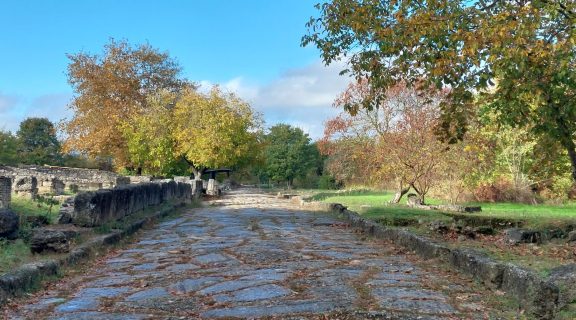
Walls and Urban Planning System
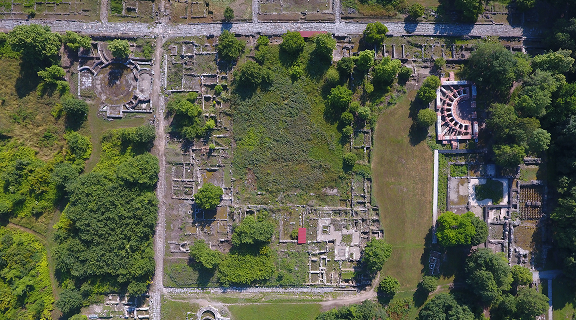
Roman Agora Building Square
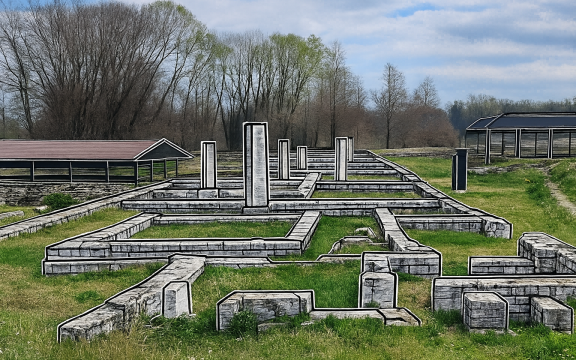
Dionysus Mansion Sector
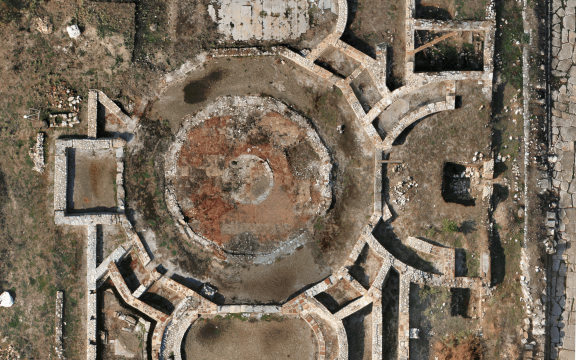
Polygonal
Building Sector
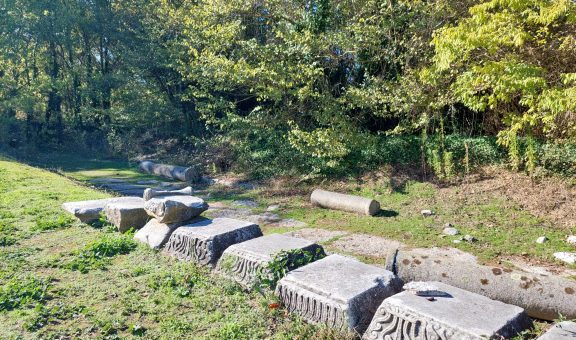
Episcopal Basilica Sector